Flat Court vs D-Shape Wedding Bands: Which Profile Is Best for Men?
Flat Court and D-Shape Profiles
A wedding band profile is simply the cross-section of the ring. Slice the ring in half and look at the cut edge: that silhouette tells you how the band sits against the finger, how light catches it, and how it feels during a long day at a desk, on site or behind the wheel.
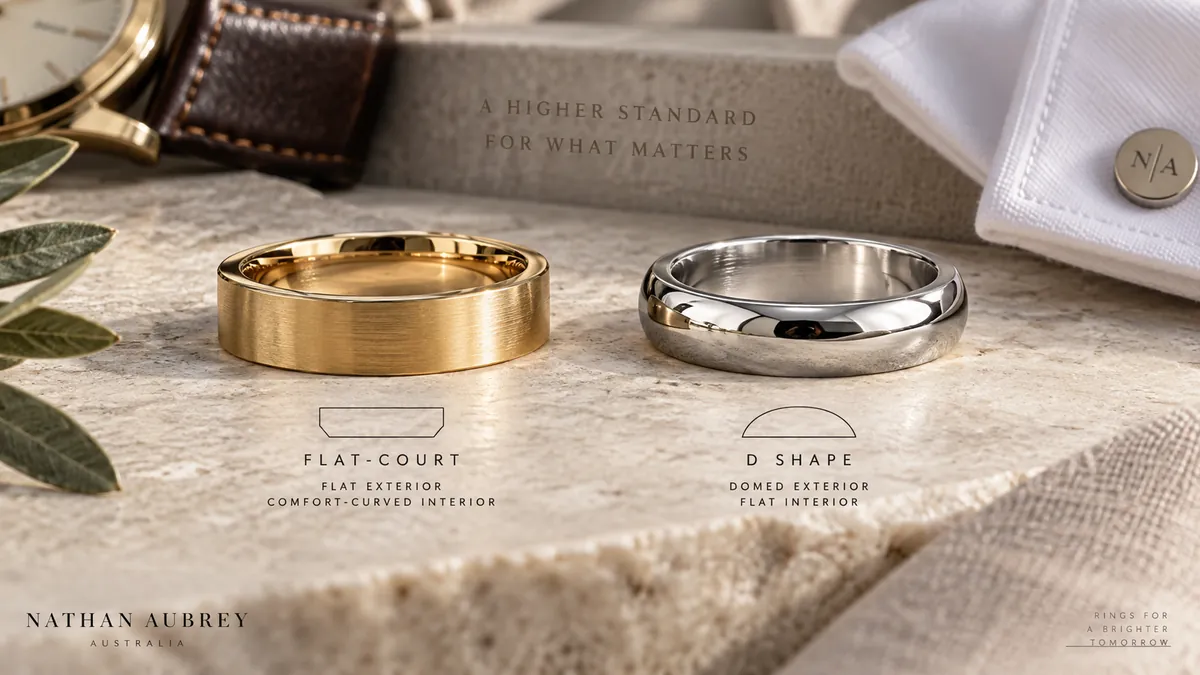
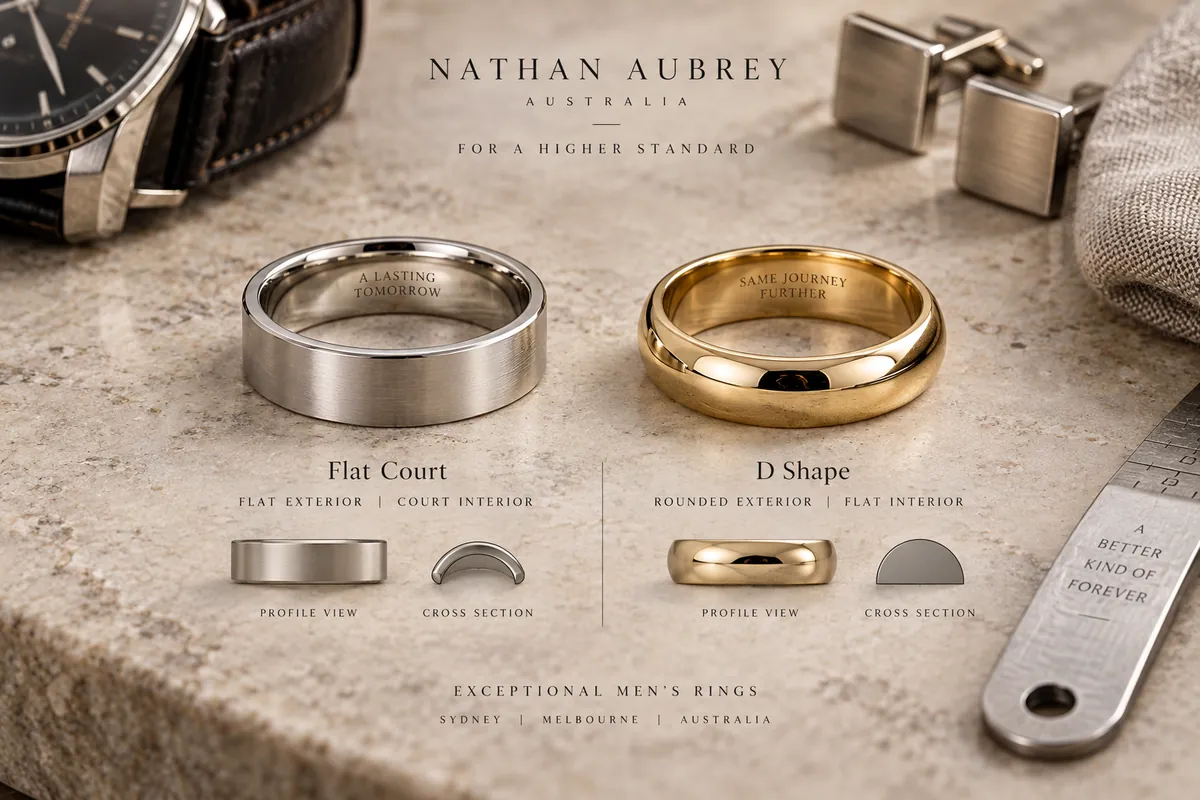
A flat court band has a flatter outer face with softened, rounded edges. Its defining feature is the inside: it is curved, or “courted”, rather than completely flat. That rounded interior means less metal makes contact with the finger. It also leaves a small amount of space beneath the band, which can make a noticeable difference if your hands swell in Brisbane heat or after exercise.
A D-shape wedding band is named for its cross-section. The outside is rounded like the curved side of a capital D, while the inside is generally flatter. It is the traditional wedding-band profile many people picture first. The curved exterior gives it a clean, familiar line and makes a polished finish look particularly bright.
Neither profile is automatically better. But if comfort is your first priority, flat court has the edge. If you want the classic rounded wedding-band appearance and enjoy a more direct, grounded fit, D-shape is hard to beat. The choice is less about following a rule and more about deciding what you want to notice, or not notice, every day.
There is a practical reason jewellers discuss profile before decorative details. Two 6 mm bands in the same metal can look alike in a photograph yet feel entirely different because one is a flat court and the other a D-shape. The same is true of weight. A heavy, solid D-shape can feel reassuringly substantial, while a court profile of comparable width may feel easier to wear because of the reduced inside contact.
Choosing the Right Profile
Start with your hands, not a product photo. Broad fingers can carry a wider band beautifully, but a wide D-shape can feel quite present on the hand. A 6 mm or 7 mm flat court often makes a sensible first try because the rounded inner profile takes the edge off that extra width. Narrower bands, around 3 mm to 5 mm, are usually easy to wear in either profile.
Think honestly about whether you wear rings now. If you already wear a signet ring, you may enjoy the positive, familiar fit of a D-shape. If a ring feels foreign after an hour, choose flat court. There is no prize for selecting the more traditional profile and then leaving it in a bedside drawer.
Finger shape matters too. On fingers that are fuller at the knuckle, a comfort-fit interior can make getting the ring on and off less irritating. It does not replace correct sizing, but it is more forgiving through normal daily changes. The best way to settle the question is to use a proper ring sizer and assess the size at different times of day.
For men who work with their hands, profile should sit alongside safety and work practice. No wedding ring profile is suitable for every task. If there is a risk of snagging, crush injury or electrical contact, remove the ring as required by your workplace. For ordinary daily wear, a low, smooth flat court has fewer sharp transitions to catch on fabric than a ring with raised detailing.
Style preference still counts. D-shape has a distinctly conventional character: curved, polished and recognisable from across a table. Flat court looks more contemporary, especially in a brushed finish. It has a cleaner plane across the top, which suits men who prefer architectural lines over a domed look.
If you are choosing alongside a partner, do not assume matching bands need matching profiles. A shared metal colour, engraving date or finish can create enough connection. One person can wear a slim D-shape while the other chooses a 6 mm flat court. Wedding rings should look related, not identical by administrative decree.
Styles, Metals and Finishes
Profile and metal work together. Yellow gold gives both shapes warmth and a strong traditional feel. In a flat court, yellow gold can look crisp and deliberate; in a D-shape, it reads as the familiar classic wedding band. Browse yellow gold men’s wedding rings if that rich colour is what you have in mind.
White gold makes the distinction more subtle from a distance. Its cool colour and reflective finish can make a D-shape look sleek rather than old-fashioned, while a brushed flat court becomes restrained and modern. The available white gold wedding-ring styles are useful for comparing the effect of profile against the same family of colour.
Platinum is dense, naturally white and valued for its enduring character. It works exceptionally well in a flat court because the profile feels smooth and substantial without becoming fussy. A D-shape platinum band, meanwhile, has a formal presence that suits a simple high-polish finish. See the range of men’s platinum wedding rings for examples of how the metal changes the visual weight of a profile.
Silver offers a brighter, more relaxed look, particularly in broader brushed bands. It can be a sensible option for a particular aesthetic, though it is softer than platinum and wears differently over time. The relevant men’s silver wedding rings make it easier to compare widths before settling on profile.
Finish is where many men make the final call. High polish makes a D-shape’s rounded top gleam. Satin or brushed finishing plays to a flat court’s wider face and disguises the fine marks that everyday wear eventually brings. A polished ring is not “less practical”; it simply records its life more visibly. Some people love that. Others would rather have a finish that stays visually quiet between professional cleaning.
For metal terminology, purity stamps and what 9ct, 18ct, 22ct and platinum markings mean, read the guide to Australian gold and platinum hallmarks. It is worth understanding the stamp inside the band before you choose the outside profile.
Before You Buy
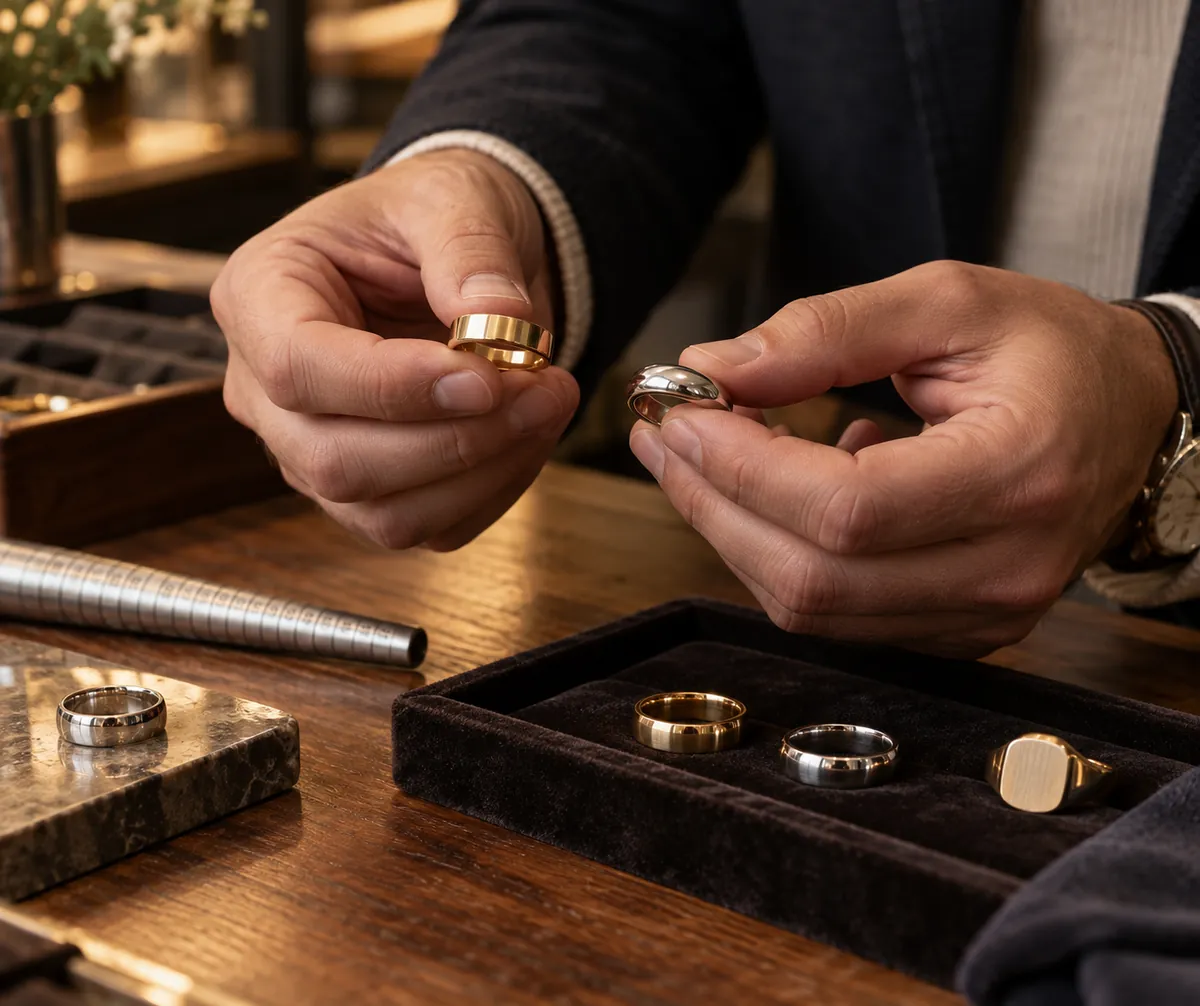
Width, depth and profile are a three-part decision. Width is what you see from above. Depth is the metal from the outer surface to the inner surface. Profile is how those surfaces are shaped. A 5 mm band can be slim but deep; an 8 mm band can look broad yet feel unexpectedly light if it is made with less depth. Ask for all three measurements.
Do not choose a ring size from a string, an old chart or one hurried try-on. Measure at a normal temperature, ideally more than once, and factor in whether your knuckles are larger than the base of your finger. A correctly sized D-shape should pass the knuckle with a little resistance and settle securely. A correctly sized flat court may feel easier to move because of its rounded interior, which is exactly why sizing it properly matters.
Confirm whether the band is solid and how it may be resized. Precious-metal wedding rings are made to be worn for years, and a small future adjustment is sometimes possible, depending on design, metal and any stones. A plain band is typically simpler to alter than one with a continuous patterned edge or diamonds set around the circumference.
If you are considering a diamond detail, keep its effect on profile in mind. A small flush-set diamond can sit neatly in a flat court face, while a D-shape’s curved surface can make a single centred stone feel more traditional. Explore platinum diamond wedding rings if you want to see that contrast in a precious-metal setting.
Buy the ring that fits your actual wardrobe and workday. A high-polished D-shape may be perfect for a man who wears tailoring most days. A brushed flat court may fit better with casual clothes, tools and a more understated style. Both can be beautifully made. The mistake is treating “premium” as a particular profile rather than excellent metal, careful proportions and a fit you genuinely enjoy.
Gold and platinum have distinct physical properties, not just different colours. The United States Geological Survey’s gold information and the Royal Society of Chemistry’s platinum profile provide useful background on these metals. In practice, ask to feel the ring rather than trying to infer every comfort detail from a specification sheet.
Tips from Ring Makers
Try on more than one width in the same profile. Men often decide they like D-shape or flat court after trying only one sample, when the real issue was that the width was wrong. Test 4 mm, 5 mm and 6 mm if you are unsure. That three-size comparison usually tells you far more than another evening of scrolling.
Keep the band on for a few minutes in the showroom or at home with a sizing sample. Close your hand, hold a phone, put your hand in a pocket and make a fist. A flat court should feel smooth at the edges without spinning too freely. A D-shape should feel secure without pinching at the knuckle.
Consider engraving early. A courted interior has a gently curved engraving surface, while a flatter inside can provide a different look for lettering. Neither is inherently superior, but short wording tends to read cleanly in either. The guide to wedding-band engraving ideas is a good place to plan dates, initials or a private line before production begins.
Make your final choice under ordinary lighting. Jewellery counters are designed to make polish sparkle, which is fair enough, but it is not your kitchen, car or office. Look at the band near a window and under softer light. A brushed flat court often looks more refined away from spotlights; a polished D-shape keeps its curved highlight in most conditions.
Finally, do not confuse a wedding ring with a signet ring. They can sit well together, but they do different jobs visually. If you wear both, leave enough contrast in width, finish or finger placement so they do not compete. The men’s gold signet ring collection can help you judge that pairing in context.
FAQ
What is the best flat court vs D-shape wedding band?
For most men seeking all-day comfort, a flat court band is the best starting point because its rounded inner surface reduces pressure on the finger. A D-shape is best for someone who wants the familiar rounded exterior and a more traditional wedding-band feel.
How do I know which flat court vs D-shape is right for me?
Try both profiles in the width you expect to wear, then make a fist, use your phone and keep the samples on for several minutes. Choose flat court if comfort disappears into the background; choose D-shape if its classic curve feels more natural and looks right on your hand.
What should I look for when buying flat court vs D-shape?
Check the width, depth, metal purity, finish, ring size and whether the band is solid. Ask how the profile will feel at your chosen width, whether resizing may be possible, and how an engraving or diamond detail could affect the design.
Are there budget-friendly flat court vs D-shape options?
Yes. A narrower band, a lower gold purity or sterling silver can reduce the upfront cost while retaining a considered profile. Focus on correct sizing and a shape you will wear, then choose the precious metal and finish that fit your budget and daily life.

